Thursday, July 19, 2012

on life and death

yesterday i headed out to the slums for what i thought would be a day of teaching health classes. i guess i should have remembered that the number one rule in india is that things never go as planned. but i guess that's not the point here either.

after our first very successful alcohol and tobacco class with a great group of men and women, we headed to a second slum to hold another class. when we got there, something was different. it was lacking it's normal feeling of vibrancy - of life. no one was outside, no one was greeting us.

shortly, we found out that a man in the community had passed away within the last half hour. and it wasn't any man - it was the beneficiary of our first soilet this year, and whose wife we'd helped plant a garden with. we were so sad to hear of his loss.

the health workers we were with - our translators and friends - invited us to come with them and give our condolences. as we approached, we could hear the wife's cries. arriving at the house, we each hugged her as she continued her heartfelt mourning. i felt her sadness and teared up, but i know i can't begin to understand it. so many years of living with someone, living for someone.

but on our way to the bus (having forgone the class), our friends pointed out to us some gardens we'd helped to plant. they were sprouting, sprouting with the vibrant green of new life. and so soon after they were planted. it's strange, but it brought me a little hope and a little happiness. it was just such an interesting contrast, and it made me think about life and death and why we're here and how things keep on living, but other things expire.

i guess don't have any major insights to share with this, but the experience pricked me. i just know that life is beautiful and precious, and it's the same everywhere.

katrina

Tuesday, July 17, 2012

An Evaluator's Experience - Part 2

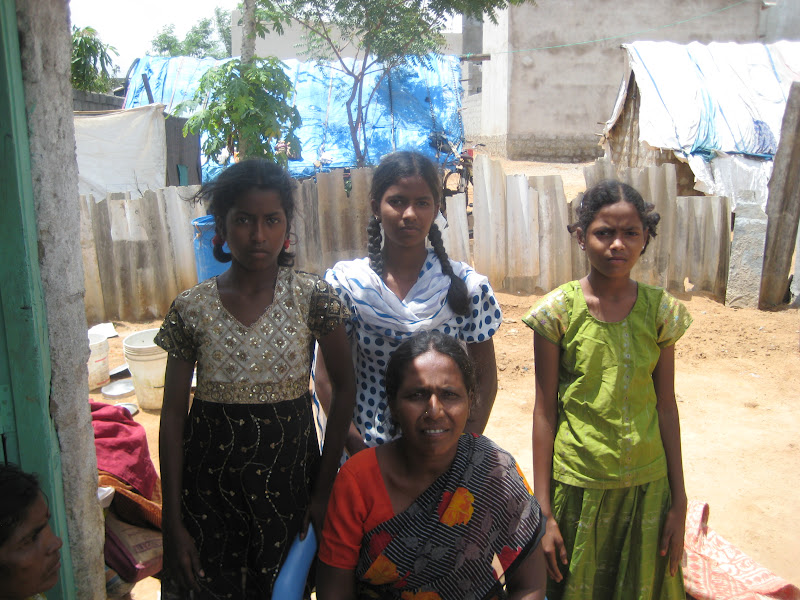
One of the families I've had the pleasure of interviewing touched me in a particularly special way. I'll leave their names confidential, but share a photo they gave permission for me to have for personal use. But first, the back-story.

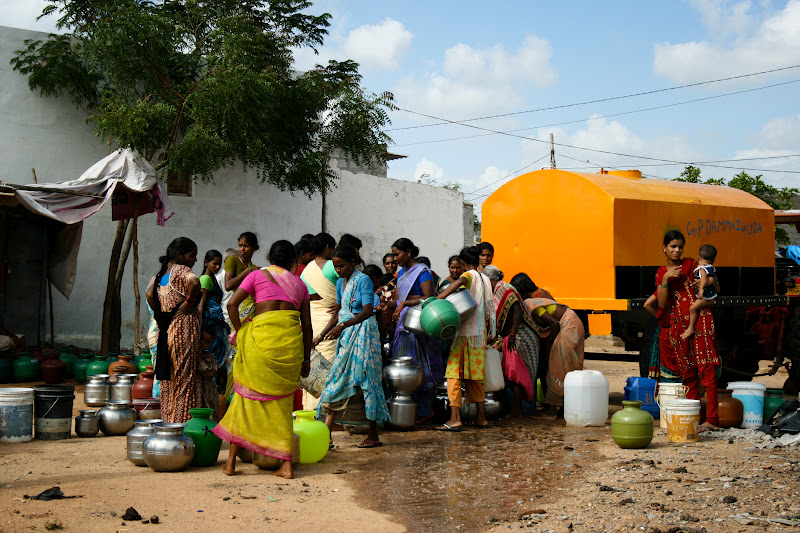
Water availability has come up this year over and over again as the number one concern of most families in the slums surrounding Hyderabad. The delayed monsoon has amplified the difficulty of the situation. Women spend hours every day waiting in lines and carrying water on their shoulders home - only to find it's not quite enough and that they have to use the same water they cooked with for cleaning those dishes. They only have the time and energy to get enough water to bathe once a week. And the water isn't clean enough to drink anyways, so they have to spend a big chunk of their income on safe water that comes only every-other day in big water trucks.


Hopefully that gives you a brief sketch of the picture here. Usually the challenge of getting water is such a fiasco, and the water is so heavy, that families reserve this chore for adults. Kids can't really handle it. At least, for most families, besides this particular one. There's four girls - a Mom with three daughters. The mother happens to have some physical and mental handicaps that make it near impossible for her to fetch the water. The task has fallen to her three adolescent daughters. They're the bravest girls I've met here.


Every day after school they start the trek to find the water. For a long time they had to beg others in neighboring slums for permission to use their pump wells. When they finally get permission to use the water, they start pumping (which is no easy task for a child when the water has to be coerced from 400 feet below ground). By the time they carry the water home, they are already late into their homework and hopefully finish before the sun's down (since there's no reliable power for light in their little shanty for light). 

Their mom does what she can, and relies on her daughters to do what they can. The best part is that they smile and laugh (except in photos... the get real serious!), and then the way they worked together to help answer my questions... You could see they're close, and that they're a trusting team. Being with them made me grateful for many things. For family, for what I have, and mostly for being here to do what I can for them.

Evaluators don't get to build new borewells. That's the other hard part about my responsibilities here. But, hopefully HELP will get four borewells drilled nearby this family's little home this summer. That's the plan, and we find out if it gets funded next week. Either way, I'll have no physical hand in the drillilng but perhaps the lessons I'm learning will benefit those who do. Until then, families like these will just keep holding on. 

Saturday, July 14, 2012

An Evaluator's Experiences - Part 1


Evaluation. Assessment. Loaded words, even outside of India... People automatically feel threatened, judged, and, well, evaluated. No one likes that, and no one likes having their lifelong, personally invested programs and projects looked at by someone else... So sometimes out here, despite my best efforts, I'm the unwanted outsider. That's the challenging, albeit sometimes necessary, part of my job. I want to talk about the beautiful part: the people! I've spent the last couple weeks working with the locals of India, learning about their perspective of the work that's been done for them in past months. It's been a pleasure in more ways than I anticipated.

A group discussion with women in a Hyderabadi slum
For instance, this last Wednesday I sat down with a group of seven Lombardi women of rural, tribal, impoverished India. They live in a quaint hamlet of only nine homes some two hours outside of Hyderabad, and they have been forgotten by government and exploited by everyone else for years. CARPED and HELP International have been trying to empower and assist them in a variety of ways. I went to find out more.

I spent the first two hours just being with them. I was there as they pumped water out of well and carried it around to their homes. They laughed when I tried to help. Apparently, this is not the man's job around here... They also showed me inside their houses, with beautifully painted doorframes, thatched roofs, and the like. Then we sat on a woven mat under the trees, and just talked. As much as possible anyways. This old lady even cracked a lot of jokes about me and laughed and laughed. Apparently my mustache, Indian outfit, and white skin clash a little. :)

The evaluation part of things has been successful in many ways, and I'm learning a lot about the work, about the people, and about myself. But the best part has certainly been meeting these individuals that give meaning to the months of preparation, the literature reviewed, the proposals prepared, the interviews practiced. It's the people that indeed are the pleasure of this practice. Thanks India.

Monday, July 2, 2012

These cuties!

So our cook Jaya not only makes the BEST food, but she also has the CUTEST daughters! We get to play with them every day (at least when we're home in time and they come with their mom), and I am going to miss them sooo much when we go. They are the most well-behaved and beautiful girls.

Here, now you can fall in love with them too.

 Ruchita - we call her Ruchi for short. It means "taste" - like good taste.

 Poojitha - we call her Pooji. She is a-dorable.


Monday, June 25, 2012

The remnants of history

Sometimes you get to feel like you’re living in Lord of the Rings. At least Kyle thinks so because he was in New Zealand for two years. Here in Hyderabad, that same feeling happens at Golconda Fort, a massive edifice that is left over from the fourteenth century. It’s a sprawling fortress that is crumbling and decaying, but the biggest single-day adventure we’ve had so far.

The first time we saw Golconda we were just driving down the road, and all of a sudden this massive castle on a hill came into view. It was so alarming, like going back in history or perhaps into Narnia or something. It also helped that the actual road you're driving takes you through the main gate of the massive outer wall, which is 11 km in circumference and so thick it feels like you drove through a short tunnel. It's another kilometer or so from the outer wall to the inner wall and the actual fort itself. It was amazing.


Approaching the outer wall gate - it appeared after the wall itself opened up and had you go through a gauntlet with two towering walls on both sides... So cool.
If Golconda was in the US, there would be a million little signs that say “please stay on the marked path” and little forest rangers to warn you not to go to far from the main road, and little museum guards to tell you not to touch anything. There were none of those. You’re as free as can be. We climbed all over the place, eventually making it to the top of the hill and into Golconda’s main keep, only to find there really was an easy path that could have taken us straight there. We liked the rock climbing, fortress scaling approach better.


"Coooool! What's around the next crumbling staircase?"
From the ground level - looking across the fort. You can't even tell how far it stretches from here
Looking up - towards the top and how high you gotta climb. Kyle wasn't looking at the fort though...
Also, bats. Hundreds of them. The place is so vast that in broad daylight you can walk into different cavernous rooms (like the old camel stables) and hear screeching… We decided to investigate, poked our camera up, took a picture, and then started running. The flash illuminated thousands of bats just staring down at us with their beady little eyes. So awesome.
Walking into the old camel stables - nice place...
Many, many little eyes! Thanks to A.R. from the team for braving the photo!
There were so many nooks and crannies that we could have spent days just exploring and having adventures there. It would have been the ultimate place for a scout campout, capture the flag, paintballing, marshmallow gun warring, and the like. It was splendid. Then, the sun went down while we were at the top, and it was beautiful. We never did learn much of the history of the place - until latter when we had to look it up online. But we did get to steal a kiss on top when no locals were looking. :) Thanks, India, for the ultimate time!


Sunday, June 24, 2012

Projects Update

Just realized we need to do a little updating on the work we've got going here.

Finished projects include: painted two slum schools, coordinated a summer camp, and took photos at a LEPRA Leprosy Shoe Mela. Below is the video of photos that Allie Rae and I took at the event. Prettttty awesome.


Now we've got a girls group going in the slums called GLOW Girls - Girls Leading Our World. Alee, an awesome team member, came up with the idea after running the summer camp. The older girls just wanted to talk with us. So we started this group as an opportunity to empower them with leadership skills, health knowledge, goal-setting, career/education preparation.

There are so many issues that these girls face, as basic as menstruation, that they don't have the information or know-how to deal with. So, teaching them, for example, what menstruation is and how to live with it, etc, will help them not to be scared by things but that they culturally can't talk with anyone about. The plan is to eventually make a presidency and slowly turn lessons over to them, and then to have the groups spread as these girls teach other girls. Below are a couple pictures of our last GLOW Girls session.

Showing us a journal entry from her GLOW Girls journal.
Playing games at the end of our last meeting
I love this girl... good thing she feels the same way :)
Another project that will start this week is alcohol and tobacco classes. I've been working for weeks to try and get this lesson ready, and now it's time! We will be holding single session classes with ten different groups of adults in slums. I'm nervous about the way the classes will be taken since they'll be a little controversial, but it's definitely an area that needs to be addressed.


We're also going to start music classes, case studies, various media campaigns, and many other projects... we'll try and keep you updated!

Wednesday, June 13, 2012

Two champs on the train


Today I was on the train coming back from Lingampali to Secunderabad and on hopped two young gentlemen who immediately caught my attention. They wore matching, purple and white seersucker shirts. They also matched each other’s height, build, and demeanor. Both looked remarkably happy and at one with the world around them. It’s not so much that “I own the planet” like some young men radiate. Instead, it was more of a “no matter who owns the planet, I am perfectly comfortable getting along.”


The rest of the train ride I watched these two young men. They sat for some time with their legs dangling off the side of the train, watching the city go by. Other times they half-wrestled each other, having probably too much fun right by the open train door. In fact, at one point I was standing just by them and stuck out my leg across the doorway to make sure they didn’t fall out the side.

I eventually worked my way over to them on the train. They were conversing and laughing in Telugu. I gestured between the two and asked, “Brothers?” They smiled and bobbled their heads in unison. We had a short, broken conversation. Both their names started with an “S,” but I can’t honestly remember them now. Vaguely, I recollect that one sounded like “smiley” but of course was probably way off from that. I feel like it suited anyways.

They didn’t stay still for long enough to have a thorough “get-to-know” you. Soon they were on the other side of the boxcar, enjoying themselves again. I just kept watching.

Just before my stop came, they somehow ended up back on my side of the train. One was teasing the other as he showed his gym membership card, as if it was the silliest thing in the world. I chimed in, “You like to work out?” He smiled. One thing led to another, and we found ourselves having a pull-up competition on the hand-bars attached to the ceiling. He was pretty good, but I had him…

Soon the train screetched to a halt, and we three disembarked. It took less than three seconds to lose sight of them in the crowd. But they’re out there in the city somewhere, living it up to the fullest.
I don’t know what about them stood out to me so much. They were just alive and happy about the simple fact of life, all in the midst of a relatively filthy city that is characterized only by the struggle for survival. At one point I thought of Slum Dog Millionaire and the story of those brothers. I was tempted to sensationalize the background and the future of this pair. Would one go on to be a leading gangster in a city slum? Would another work day-in and day-out on the phones in a cubicle next to hundreds of other customer services technicians? Would they both go on to earn PhDs and work with the poor, like the wonderful people we are surrounded by each day?

Thankfully, I didn’t really have to sensationalize their stories. I’ll leave that up to them. The experience was just wonderful for me to think about the future, and that even here in India, the next generation has potential. There’s a lot that needs to be done, but for today, these boys’ sense of freedom, fun, and fulfillment on one simple train ride are all that matters.

Kyle

Thursday, June 7, 2012

School painting and Shabana


A bit of the painted school
Last week we started work on a summer camp for kids in slum schools, and we painted a preschool in the slums. The summer camp was loud and busy and fun. And a learning experience. The girls running it did a great job planning lessons and keeping the kids busy. Brook and I taught them the Macarena, and they caught on so quickly… it was so fun to watch them dance. Especially to the music of the Tollywood hit “Gabbar Singh.” That’s another story entirely.

The best part of the week was getting to know the children that hung out around the school while we painted. They were all so eager to talk with us and learn from us. Once they learned my name is Katrina, they kept asking me to “Dance! Dance!” because I share my name with a famous Bollywood star… and because they probably would have asked anyway.

Most of the group in front of the school on the day we finished
This little boy seemed a little sad, but I am captured by this photo of him
 A few of the older girls in particular liked talking with me and the other volunteers, asking me my name, my parents’ names, my age, etc. When they found out I was married (Kyle wasn’t there) they were surprised. They were so interesting to get to know. A few were Hindu, some were Christian, and a few were Muslim. They all had aspirations to be teachers, doctors, policemen. They were energetic and kind, and I just wanted to spend all my time with them. When we left they said, “We are missing you,” and they hugged me a lot. So sweet.
The girls gave me a few flowers :)
Many of the girls
It seems wrong having favorites, but I have to admit I had one. Her name is Shabana, a 9th class girl and a Muslim. She had a grace and maturity about her that I admire. She didn’t join the other kids in flocking me for games and songs (thought I didn’t mind that), she just watched us through the window while we sat on the school porch. I just inherently trusted her. Near the end of the day one day, she made a beautiful henna design on my hand with my ballpoint pen. So beautiful! I was sad it wasn’t henna because it washed away so quickly. 


Shabana with a local woman who came by for a bit
Can't see it well, but this is what Shabana drew on my hand
Next week she goes off to a hostel so she can attend a special Muslim girls’ school (from what I understood), so I may not get to see her again. I really have no idea what she has experienced so far in life, and I don’t know what challenges await her, but I hope with all my heart that she finds joy in life. I hope she becomes the teacher she dreams of being. I hope she finds her way out of the slums if that is what she wants. I hope she has a kind husband when she gets married. I hope she keeps her sweetness. I hope the same for all the girls I met, and all I didn't meet. And all the little boys.

Shabana is just one girl out of millions of people in this city, but I am glad I met her and learned just a little of her hopes and dreams and talents. 


The stories behind the precious smiles

A few of us just got back from a visit to another bridge school, getting ready to do case studies on as many children as we can. We were introduced to three classes, and they were so excited to see us. Each class had a few boys who told us their stories.

I didn't get pictures today, but the boys today reminded me of these boys at the rural bridge school.
The first was the story of a boy of nine years who came to the bridge camp within the past few months. He told us that his father murdered his mother about a year ago. He moved in with his maternal grandmother, and once he came out on bail, he poisoned and killed his grandmother. A little nine year-old boy telling us this story... I can't even imagine the pain, the nightmares. He and his little three-year old brother were now living at bridge camp until he is accepted to a government school and lives in a hostel.

We heard from probably ten more children, and maybe a third of them said their parents committed suicide, and several mentioned that their parents were alcoholic. These boys had all been through difficult things like this, even if their trials had "just" been child labor. I don't think I'll ever be callous to these stories, even after I've heard a hundred.

I'm still processing things, but I do want to say that it made me even more excited for my upcoming project: teaching about alcohol and tobacco abuse in slum communities. Alcohol causes so much harm to families and individuals who are already so poor and have such difficult situations. I can't blame them for wanting a way to relax and get away, but this is not a healthy way. I know these classes will be difficult and probably not well received, but it's a start. A very important start. 

Friday, June 1, 2012

Swayam Krishi Sangam


I finally found one time of the day that isn’t boiling hot… 5:00 a.m. That’s when I had to get up to accompany one of our partner organizations out into the field to have a look at some of their programs with the “ultra poor.” It turned out to be a beautiful day, despite the early start and the fact that the heat had returned by eight o’clock.

“Ultra poor” is a phrase used by an organization called SKS, an organization we may work with this summer. The phrase refers to a state of poverty that is at the peak of destitution – when families are impoverished in every kind of way. For instance, the ultra poor that SKS focuses on are women who have been abandoned or have lost their husbands, have no education, no property, no jobs, no social support or family support, and less than 1$ a day of income (made mostly from selling themselves as day laborers to do any type of work available). The also live in rural India – the most rural part of India. We left for the outskirts of Madek district at 5:00 a.m. because it took over three and a half hours to get out to this small village.

Despite being labeled “ultra poor,” these women are still “ultra inspiring.” Our first encounter with them was at their weekly team meeting where they come and record their progress. It was amazing to see what was happening. SKS takes a couple months to teach basic principles of financial literacy. From that point on, the women are given means of livelihood (this group had been given goats to raise and sell, other women choose tailoring or other skill sets they feel best suits their circumstances). They meet in a group once a week to report how many rupees they’ve saved that week and to receive additional trainings. They also come with a handful of rice every week to deposit into their group “rice bank.” Then, any time one of them experiences some crisis, she can draw on that rice bank rather than starve. In only eight months’ time these woman had nearly filled a large tin bucket with rice.


To report their progress, the women maintain a financial ledger, both personally and as a community. We saw in their own handwriting how they reported their savings and expenditures. We also saw how at the beginning of the community ledger all they could do each week was leave a thumb print on the line that represented their contribution. Then, after flipping through a number of pages, some of the lines started showing scraggly signatures instead of thumb prints. When we’d flipped to the final page, every line had a well-practiced signature.


After this meeting, we were blessed to be invited into the homes of two of these women. The first was an aging woman who lived on her own. We walked through the village past a number of sound-looking dwellings, expecting at any time to come across her house. When we did, I must admit I did a double take. Compared to the brick and mortar houses around, her little straw-thatched home tucked between established houses looked like nothing more than an abandoned shed. Yet, she had maintained it and loved it, and it was indeed her home. We’d seen the homes of others struggling in India before. This was something different. Inside, there was nothing. No possessions. No light. Only her and her dedicated determination to push on. Our partner, Dr. Divakar, said, “You are in the home of one of the poorest women in all of India.”


We asked her about her story, and also her dreams for the future. She was alone. Her daughter and son-in-law had left and were living in Hyderabad, but never sent any support. She had lost her husband years before. She had nowhere to go. But she looked forward to improvement and peace in the years to come.

The next home we visited was very similar, but with a new story and new struggles. This woman’s husband had committed suicide a couple years ago. Now, she was working as a day laborer trying to help her three children get through school. Her two daughters were there, and we got a few shy smiles out of them. They were beautiful young girls, and this family is hoping to get all of them into higher schooling.


The rest of the day was rather administrative – learning about SKS and its history and programs. Apparently, “Swayam Krishi Sangam" means “self-help group” in Sanskrit. An appropriate title. These women are really pulling themselves forward on their own, helping each other and helping themselves. Throughout the day, the feeling these women left never dimmed. It’s humbling to think as I sit here in our comfortable flat, hours away from their village, that they are still out there, struggling, smiling, working, hoping, and trying to improve their condition. They are always out there, though rarely seen. They were there before we came, and will be there when we go back home. It’s not that I hadn’t studied poverty, and didn’t “know” that wonderful people just like me are living a very different life than I am all around the world. It’s just a new feeling to be able to put a face and a story to the statistics and lectures. When I wake up each day, wondering what I’ll be up to, they’re waking up and facing the day just like me.

Here's Brook, who accompanied me, with the SKS group
Certain social problems cannot be overcome in six or twelve weeks’ time. Hopefully we can leave something for them that will help those dreams before we return home.